When Music Becomes Memory
There's something almost mystical about the way certain albums embed themselves into the DNA of British festival culture. Not just as background music or crowd-pleasers, but as the actual soundtrack to entire generations coming of age in muddy fields across the country. These records don't merely accompany our festival experiences — they become inseparable from them, bottling entire summers into grooves and beats that still make our hearts race decades later.
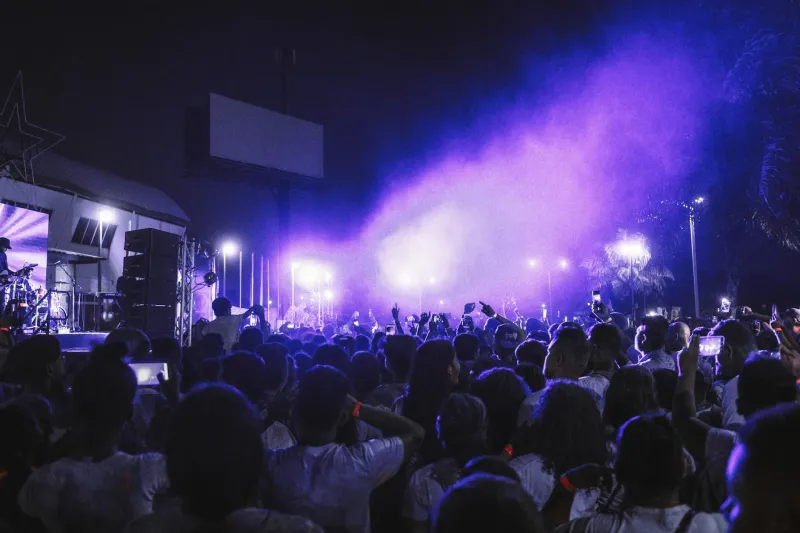
Stand in any British festival crowd today, and you'll witness something extraordinary: the moment when those opening chords kick in, transforming thousands of individual strangers into a single, breathing organism of shared memory. It's not just nostalgia — it's cultural archaeology, each song excavating layers of who we were and who we're becoming.
The Britpop Battlefield: Blur's 'Parklife' Era
Cast your mind back to the mid-90s, when British guitar music was experiencing its most confident swagger since The Beatles conquered America. Blur's 'Parklife' didn't just soundtrack the summer of '94 — it practically invented the template for British festival euphoria. Those distinctive opening bars of 'Girls & Boys' still trigger Pavlovian responses in anyone who survived that era's festival circuit.
But here's what made 'Parklife' special: it captured the exact moment when British youth culture stopped looking across the Atlantic for validation. Suddenly, being proudly, unapologetically British wasn't just acceptable — it was revolutionary. Festival crowds weren't just singing along; they were declaring independence, one 'woo-hoo' at a time.
The album's genius lay in its ability to make every listener feel like they were part of something bigger than themselves. When 'End of a Century' echoed across festival fields, it wasn't just a song — it was a manifesto for a generation refusing to be defined by their parents' limitations.
Electronic Awakening: The Chemical Brothers and the Rave Revolution
While guitar bands were conquering main stages, something equally revolutionary was happening in the dance tents. The Chemical Brothers' 'Dig Your Own Hole' arrived in 1997 like a sonic earthquake, fundamentally reshaping what British festivals could sound like. This wasn't just electronic music — it was electronic music with a punk rock heart and stadium-sized ambitions.
'Block Rockin' Beats' became the sound of a generation discovering that electronic music could be every bit as visceral and communal as traditional rock. Festival-goers who'd never set foot in a proper rave found themselves losing their minds to breakbeats and synthesiser stabs, their preconceptions dissolving in waves of MDMA-tinged euphoria.
The album's impact extended far beyond the music itself. It legitimised electronic acts as festival headliners, paving the way for the genre's complete integration into British festival culture. Today's festival landscape — where electronic acts routinely top bills alongside rock legends — owes a massive debt to those pioneering Chemical Brothers sets.
Arctic Monkeys: The Last Great Guitar Revolution
Fast-forward to 2006, and British guitar music was supposedly dead. Then four lads from Sheffield released 'Whatever People Say I Am, That's What I'm Not' and reminded everyone why guitar music had conquered the world in the first place. But this wasn't just any guitar album — it was the first truly internet-native British record, spreading through MySpace and file-sharing networks before most people had even heard of the band.
The Arctic Monkeys phenomenon at festivals was unlike anything that had come before. Here was a band whose songs were already embedded in fan culture before they'd played a single major festival. When 'I Bet You Look Good on the Dancefloor' exploded across festival crowds, it felt like witnessing the birth of a new form of collective consciousness.
What made their debut so perfect for the festival environment was its combination of local specificity and universal emotion. These were songs about Saturday nights in provincial Britain, but they captured something fundamental about youth, desire, and the search for connection that resonated far beyond Sheffield's city limits.
The Radiohead Revelation: 'OK Computer' and Millennial Anxiety
Some albums define their era by capturing its optimism; others by articulating its fears. Radiohead's 'OK Computer' fell firmly into the latter category, but in doing so, it created some of the most transcendent moments in British festival history. When those opening notes of 'Airbag' rang out across festival fields in the late 90s, something profound was happening.
This was music that acknowledged the growing anxiety and alienation of modern life while somehow transforming those feelings into communal catharsis. Festival crowds didn't just sing along to 'Karma Police' — they performed a kind of collective therapy, thousands of voices joining together to process the weight of approaching millennium.
The album's electronic textures and unconventional song structures also pushed British festivals towards greater sonic adventurousness. Radiohead proved that festival crowds were hungry for music that challenged as well as entertained, opening doors for countless experimental acts in the decades that followed.
Legacy in the Mud
These albums didn't just provide soundtracks to British summers — they helped create the cultural framework within which British festivals continue to operate. They established the idea that festivals aren't just entertainment; they're spaces where collective identity gets negotiated and renewed.
Today's festival landscape, with its genre-blending lineups and emphasis on cultural experience over pure musical consumption, owes everything to these pioneering records. They proved that the right album, at the right moment, can transform a field full of strangers into a community united by something larger than themselves.
As we look towards future festival seasons, we're still searching for that next record that will define our collective experience. But perhaps that's the point — the magic happens not in the seeking, but in those unexpected moments when music and memory collide, creating something entirely new from the beautiful chaos of British festival culture.