Your Brain on Glastonbury: The Science Behind the Festival Spark That Lasts All Winter

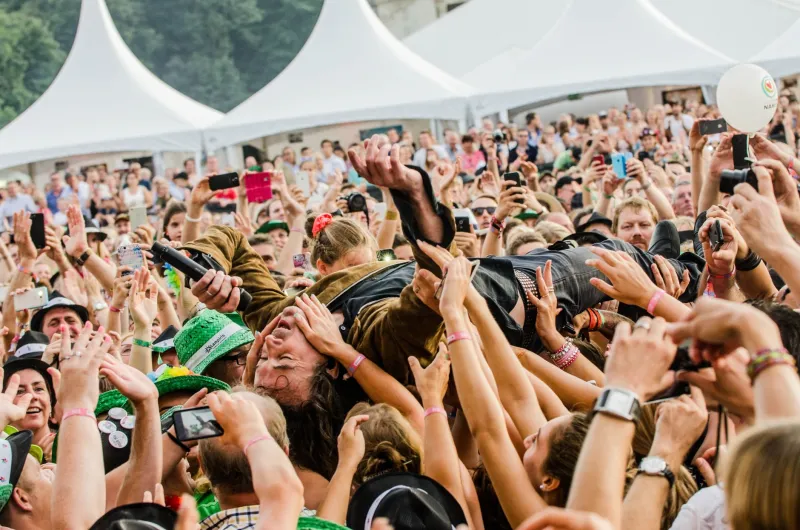
Photo by Photo by Phil Hearing on Unsplash on Unsplash
It's October. The wellies are washed, the wristband's long gone, and yet something lingers. You've started sketching again. You picked up the guitar that's been gathering dust since university. You pitched that idea at work you'd been sitting on for three years. You can't quite explain it, but the festival did something to you — and it doesn't seem to be fading.
You're not imagining it. And you're definitely not alone.
What's Actually Happening Up There
Dr. Harriet Moss, a cognitive neuroscientist based in Sheffield who has spent the last decade studying the relationship between collective experience and creative cognition, puts it plainly: "Festivals are one of the most neurologically rich environments a human being can voluntarily enter."
The combination of novel stimuli — unfamiliar music, unexpected visual art, new social connections, disrupted routines, even altered sleep patterns — triggers what researchers call a 'neural shakeup'. In plain English, your brain is forced out of its default mode, the well-worn grooves of habitual thinking that govern most of our daily lives.
"When the default mode network is disrupted and then reintegrated," Moss explains, "there's a window — sometimes lasting weeks or months — where associative thinking becomes easier. The connections between seemingly unrelated ideas feel more natural. That's essentially what creativity is."
It's not magic. It's just your prefrontal cortex getting a proper jolt.
The Artists Who Credit the Field
Manchester-based painter Soraya Okonkwo had her first solo exhibition last spring. The centrepiece — a vast, layered canvas mixing West African textile patterns with British industrial imagery — was conceived, she says, in a single afternoon at Green Man Festival two summers ago.
"I was watching this band I'd never heard of, standing next to a woman who turned out to be a textile designer from Lagos, and we got talking about pattern and rhythm and colour," she recalls. "Something just unlocked. I went home with pages of notes and this feeling that I'd been given permission to make the work I'd been afraid to make."
Soraya's story is striking, but it isn't unusual. Across Britain, artists, writers, musicians, and designers describe festival experiences as catalysts — not gentle nudges but full structural shifts in how they approach their craft.
Leeds-based songwriter Tom Birchall, who releases music under the name Pale Harbour, describes the phenomenon differently. "It's not inspiration in the romantic sense. It's more like... recalibration. You go to a festival and you hear ten artists in a day, some brilliant, some baffling, and your internal compass resets. You come back knowing more clearly what you want to say."
The Role of Collective Joy
Psychologist Dr. Priya Sundaram, who studies group emotion and wellbeing at the University of Bristol, points to something she calls 'communal resonance' as a key driver of the lasting festival effect.
"When thousands of people share an emotional experience simultaneously — particularly one involving music, which is deeply tied to memory and identity — the brain encodes it differently to a solo experience," she says. "The social dimension amplifies the emotional intensity, and emotionally intense memories are more deeply integrated. They don't just fade into background noise."
This matters for creativity because creative blocks are often tied to emotional stagnation — a kind of psychological fog that settles when we feel isolated or stuck in routine. Festivals, Sundaram argues, are one of the most effective antidotes to that fog that British culture has produced.
"There's something very specific about standing in a crowd of strangers who are all, for one moment, feeling exactly what you're feeling. It's a reminder that the interior life isn't private property. That's profoundly freeing."
Nostalgia or Transformation? Asking the Honest Question
Not everyone is entirely convinced the effect is as lasting as people believe. Dr. James Whitfield, a psychologist at UCL who studies memory and mood, urges some caution.
"There's a well-documented phenomenon called 'rosy retrospection' — we tend to remember peak experiences more positively over time, and we often attribute more significance to them than they had in the moment," he says. "The question is whether the creative output people associate with festival experiences would have emerged anyway, and they're simply anchoring it to the festival."
It's a fair challenge. But even Whitfield acknowledges the environmental conditions festivals create are genuinely unusual. "You're removing people from their normal context, exposing them to concentrated novelty, giving them permission to be playful and open. Whether you call it transformation or just a very good reset, the functional outcome is similar."
Chasing the Glow, On Purpose
Some people are starting to approach festivals with this science consciously in mind — not just going to have a good time, but treating the experience as deliberate creative investment.
Birmingham-based graphic designer Callum Reeves has attended at least two UK festivals every summer for the past six years, always bringing a sketchbook. "I used to feel guilty about it, like I was being precious. Now I think of it as research. The things I absorb at festivals — visually, musically, in conversation — show up in my work for the rest of the year. It's the most efficient creative development I do."
Dr. Moss sees this as an encouraging shift. "If people start treating cultural immersion as a legitimate tool for maintaining creative health, that's a really positive thing. Festivals aren't frivolous. They're one of the ways humans have always refreshed themselves."
Looking Forward
As the UK festival calendar continues to diversify — with more genre-blending, arts-integrated, community-centred events emerging every year — the relationship between attendance and creative output feels increasingly worth taking seriously.
From Now On has always believed that festivals aren't just a weekend away. They're an investment in the version of yourself that comes home on Monday morning. The science, it turns out, is starting to agree.